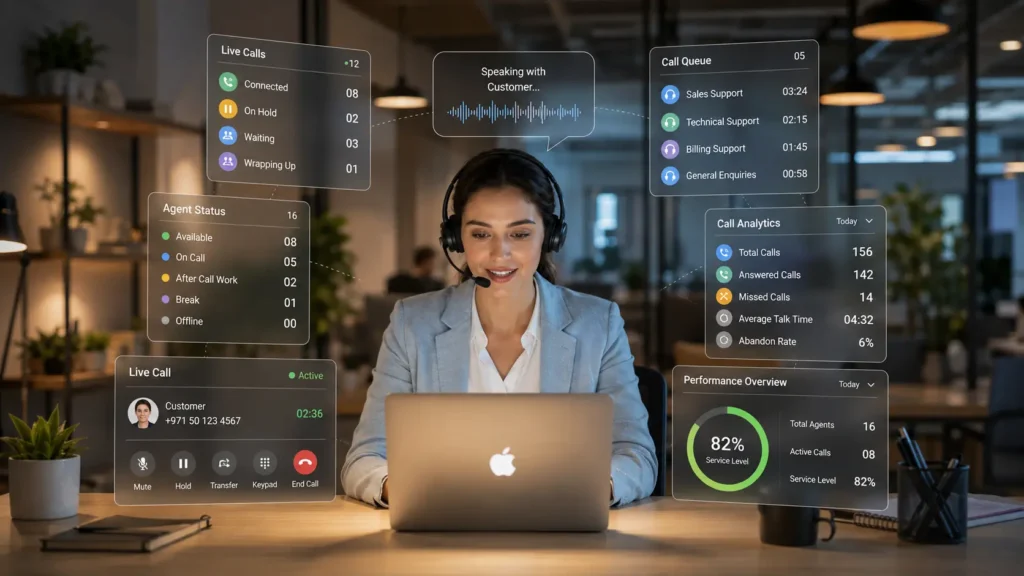
Short answer, no business needs to switch on every feature a contact centre solution offers. But almost any business can use a contact centre solution, starting with just the piece it actually needs today, whether that is an outbound dialer, inbound call handling, CRM integration, or customer messaging, and adding more later as it grows.
The right contact centre solution depends on your call volume, number of agents, the channels your customers actually use, and where the business is headed. A small team might begin a contact centre solution with just a dialer. A larger organisation might need a contact centre solution with inbound queues, support tools, and every channel connected from day one.
The key thing people get wrong about a contact centre solution is treating “dialer” and “contact centre” as an either or choice. Most modern contact centre solution platforms are modular. You activate what you need now and add capability to your contact centre solution later without switching systems.
What a Contact Centre Solution Actually Is
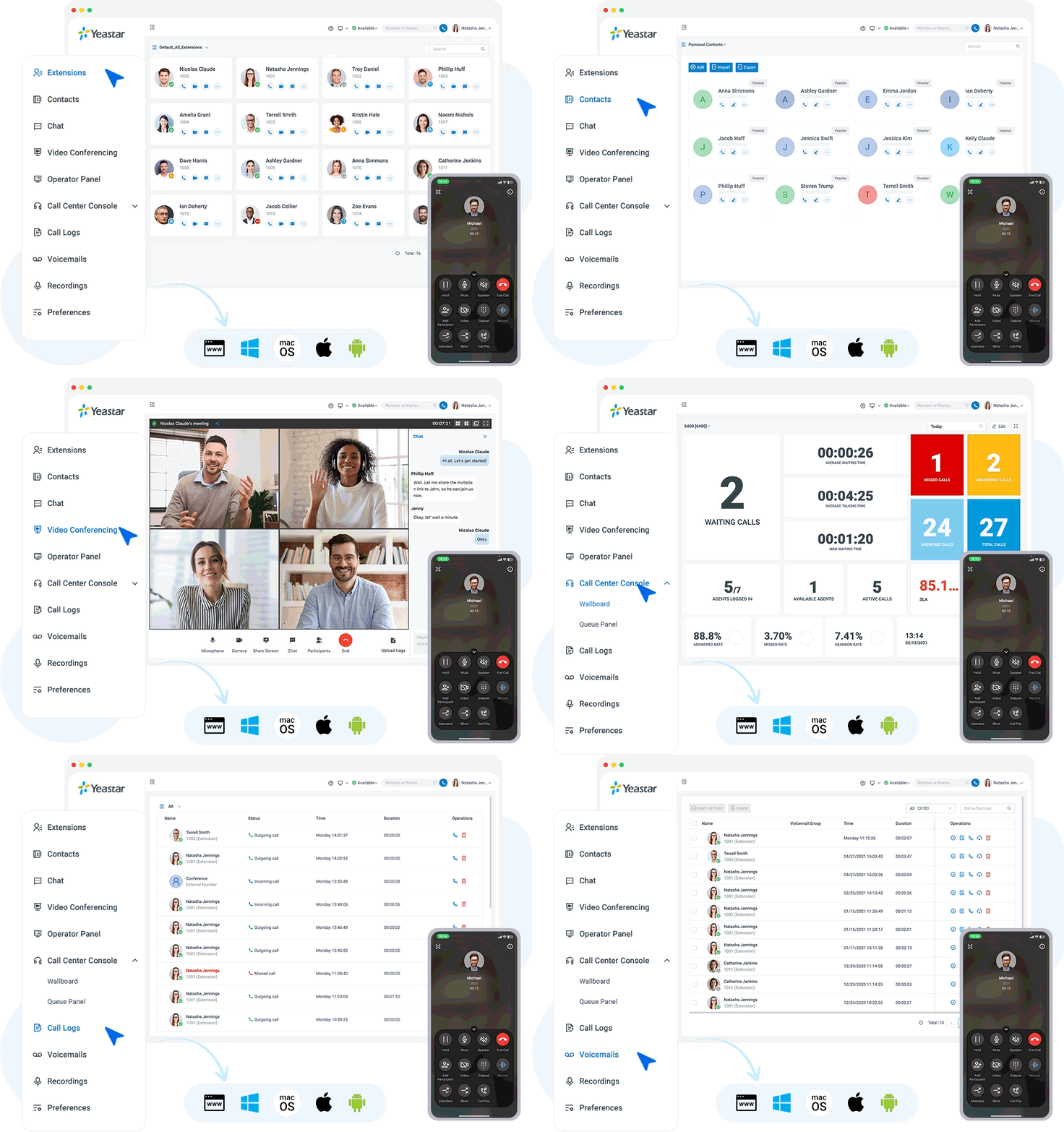
A contact centre solution is software, an IT and telecom setup, not a customer care agency. With a contact centre solution, an IT support provider like FSI Information Technology installs, configures, and supports things like:
- Business phone numbers and IP phones or softphones
- IP PBX and IP Office systems
- IVR (interactive voice response)
- Call queues and automatic call distribution
- Call routing and recording
- Outbound dialers
- CRM and helpdesk integration
- Agent dashboards and supervisor monitoring
- Call reports and analytics
Your own employees still handle the calls and customer conversations through your contact centre solution. The provider supplies and manages the contact centre solution underneath, often built on an IP PBX or IP Office system, whether that runs on your own infrastructure or through a cloud subscription.
Contact Centre Solution vs Call Centre Agency
This is the mix up that trips most people up. A contact centre solution is not the same as hiring a customer care company to answer calls for you.
| Point | Contact centre solution | Call centre agency |
|---|---|---|
| What it provides | Software and communication infrastructure | Agents and outsourced service operations |
| Who answers the calls | Your own employees | The agency’s employees |
| Who manages the agents | Your business | The third party agency |
| Main service | Contact centre solution setup and support | Customer care, sales, or support delivery |
| Typical provider | IT services or telecom company | BPO or outsourcing company |
In plain terms: a contact centre solution is a technology setup for your business. A call centre agency is a company you pay to handle calls for you, sometimes called a BPO. A contact centre solution keeps the work in house, a call centre agency hands it off.
What a Dialer Solution Is

A dialer is built for outbound calling. It helps sales, marketing, or follow up teams get through contact lists faster, with features like:
- Power, preview, and predictive dialing
- Contact and lead lists
- Callback scheduling
- Call outcome tracking and campaign reports
- CRM integration
A dialer can stand alone, or it can be one module inside a bigger call centre or contact centre solution. A real estate company might add a dialer to its contact centre solution to work through property leads. A recruitment agency might use one to call candidates. An education provider might use one to follow up on enquiries.
Can a Business Use Just the Dialer
Yes. A company can pick a contact centre solution and switch on only the outbound dialer, agent accounts, contact lists, recording, CRM integration, and campaign reports, while leaving inbound queues, IVR, email, chat, and social messaging turned off.
As the business grows, it adds what it needs to the same contact centre solution, rather than starting over with a new system.
Call Centre Solution vs Contact Centre Solution
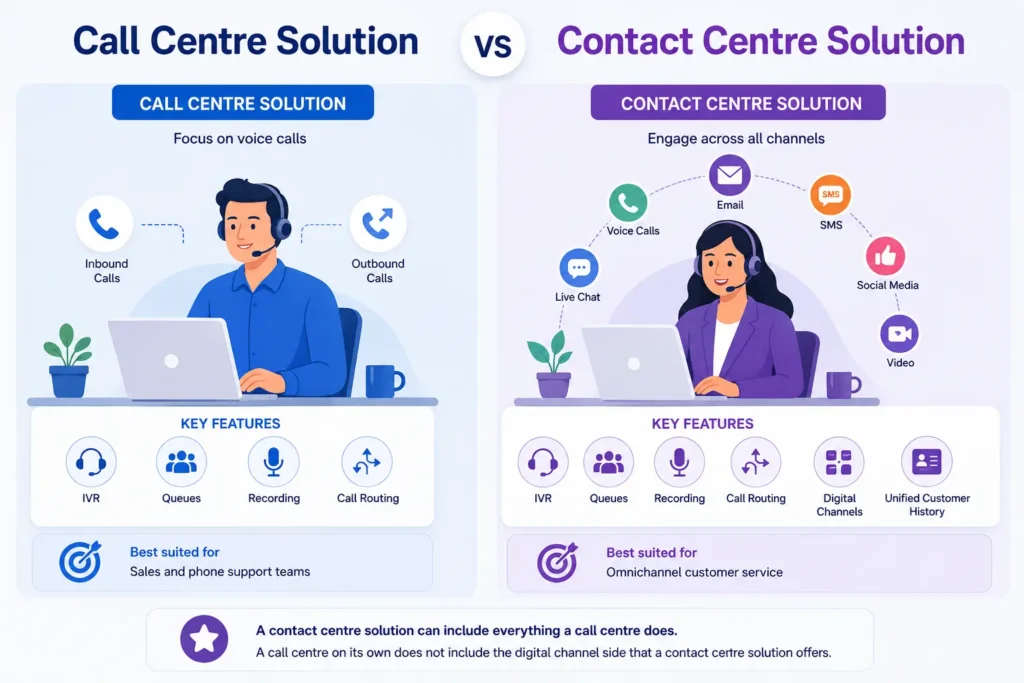
| Feature | Call centre solution | Contact centre solution |
|---|---|---|
| Main purpose | Manage phone calls | Manage communication across channels |
| Channels | Inbound and outbound calls | Calls, email, chat, SMS, social, and more |
| Best suited for | Sales and phone support teams | Omnichannel customer service |
| Typical features | IVR, queues, recording, routing | All of that, plus digital channels and unified customer history |
A contact centre solution can include everything a call centre does. A call centre on its own does not include the digital channel side that a contact centre solution offers.
Matching the Solution to the Business
| Business situation | Fits best with |
|---|---|
| One to five people, limited calls | A basic business phone system |
| Small outbound sales team | A power dialer or outbound calling platform |
| Support team handling regular call volume | An inbound call centre solution |
| Sales and support sharing one setup | A blended call centre |
| Customers reaching out by call, chat, email, and messaging | A contact centre |
| Large operation needing automation and deep reporting | An enterprise contact centre |
Company size matters less than actual call volume and how many channels customers use to reach you. A five person sales team running a dialer off their CRM often needs nothing more. A bank or a hospitality group juggling calls, email, and chat across departments needs a full contact centre solution.
Questions Worth Asking a Provider
Before choosing a contact centre solution, it is worth asking:
- Can we start our contact centre solution with just the dialer
- Can we add inbound calling later without switching platforms
- Are email, chat, and messaging optional add ons to the contact centre solution
- Does the contact centre solution integrate with our CRM
- Is pricing based on users, features, or usage
- Can we scale our contact centre solution up to a full deployment down the line
These answers tell you whether the contact centre solution you are buying gives you flexibility or locks you into more than you need.
The Bottom Line: Choosing the Right Contact Centre Solution
A dialer handles outbound calling. A call centre manages structured inbound and outbound calls. A contact centre solution brings calls, email, chat, and messaging together in one place. And a modular contact centre solution lets a business start with just one of these and expand only when it actually needs to.
The better way to frame it isn’t “you only need a dialer, so a contact centre solution isn’t for you.” It’s closer to this: you can run a contact centre solution with just the dialer switched on today, and add the rest whenever your business is ready for it.
And the distinction worth remembering above all else: a contact centre solution is a technology setup for your own team. It is not the same thing as outsourcing your customer care to an agency.
So the real question isn’t whether you need a contact centre solution. It’s what type of contact centre solution you need, a full deployment, or just specific features like call centre or dialer switched on. If you are still unsure what contact centre solution fits your company or enterprise best, get in touch with the IT support team at FSI Information Technology for a free consultation today and we will help you figure out the right starting point.
Frequently Asked Questions
No. A very small business with limited calls may only need a basic phone system. A contact centre solution becomes useful once call volume grows or customers start reaching out across multiple channels.
A contact centre solution is technology your own team uses to manage calls and messages. A call centre agency is a company you hire, whose own staff answer calls on your behalf.
Yes. Most contact centre solution platforms are modular, so you can activate only the dialer now and add inbound calling, CRM integration, or digital channels to your contact centre solution whenever your business is ready.
No. A dialer is a feature built for outbound calling. A contact centre solution is a broader platform that can include a dialer along with inbound calls, email, chat, and more.
It comes down to how customers reach you. If phone is your only channel, a call centre solution is usually enough. If customers also use WhatsApp, email, or chat, a contact centre solution keeps everything connected in one place.
An IP PBX is the underlying phone system that routes calls over your network instead of traditional phone lines. IP Office is a specific business phone platform built on that same IP PBX technology, often used as the hardware and software base that a contact centre solution runs on.
That is normal, especially with so many overlapping terms. Book a free consultation with the IT support team at FSI Information Technology and we will walk through your call volume, channels, and goals to recommend the right contact centre solution.