If your business phone lines are always ringing, you probably already know the issue: many calls, not enough people to handle them in the right way. Customers wait longer than they should on hold; some agents are overwhelmed while others have nothing to do, and in the middle of all that, some calls are missed. It’s annoying for your team and even worse for the person waiting on the other end.
This is the kind of issue an ACD solution in Dubai is made to fix. Instead of calls going anywhere, they land in an automatic call distribution system that takes control of the flow. It gets every call that comes in, checks who is available, and sends it to the right person automatically. No guessing, no transfers, no mess.

In this blog, we’ll explain what an ACD solution really is, how it works behind the scenes, and why many businesses in Dubai are using one to make their call centres run better.
What Is an ACD Solution?
Let’s keep it simple. An ACD solution in Dubai, which stands for Automatic Call Distribution. Is a call center tool that sends calls to the right agent or department based on rules you set up beforehand.
Imagine a receptionist that never sleeps. Instead of a person taking every call and trying to figure out where to send it, the system does the job instantly every single time.
Here’s what it usually takes care of:
Receiving incoming calls the moment they hit your business line
Checking availability across your team of agents
Applying routing rules you’ve defined (by department, skill, priority, or order)
Connecting the caller to the most suitable available agent
Managing the queue when everyone’s busy, so no one just gets a busy signal
For any business that gets a lot of calls, this is important. Without an ACD system for call centres, you are depending on transfers, guessing, and a lot of “Wait a second; let me see who is free.” That doesn’t grow with your business. It definitely doesn’t feel good to the customer on the line.
How Does Automatic Call Distribution Work?
The process behind automatic call distribution is more straightforward than it sounds. Here’s what typically happens, step by step:
1. Customer Makes a Call
It starts simply: a customer dials your business number.
2. Call Enters the System
The ACD picks up the incoming call and immediately starts identifying the available routing options based on your configuration.
3. IVR Interacts With the Caller
If there’s an IVR Solution Dubai connected to your setup, the caller might hear a menu, “Press 1 for Sales, Press 2 for Support”, and choose the option that matches their need.
4. ACD Identifies the Right Agent
Behind the scenes, the system checks which agents are available and applies your routing rules to figure out who should take the call.
5. Call Is Automatically Routed
Once the right agent is identified, the call is sent straight to them, no manual intervention needed.
6. Agent Handles the Call
The agent picks up and helps the customer, ideally already equipped with context if the system is integrated with a CRM.
It’s worth noting that ACD and IVR often work as a pair rather than standalone tools – the IVR gathers intent, and the ACD acts on it. If you want a deeper look at how the IVR side works, our IVR Solution Dubai page covers that in detail.
Key Features of an ACD Solution
Not every ACD platform on the market offers the exact same feature set; capabilities vary depending on the provider and the plan you choose. That said, here are the features you’ll commonly find in a solid automatic call distribution setup:
- Automatic call routing — calls go to agents without manual sorting
- Skill-based routing — calls matched to agents with the right expertise
- Queue management — organized holding for callers when agents are busy
- Agent availability management — real-time tracking of who’s free
- Call prioritization — VIP or urgent calls can jump the queue
- IVR integration — pairs naturally with voice menus
- Call queue announcements — hold messages, estimated wait times, etc.
- Real-time monitoring — supervisors can watch call activity live
- Call reporting and analytics — data on volume, wait times, agent performance
- CRM integration — pulling up customer history automatically
- Call recording integration — for quality checks and training
Again, availability of each feature depends on the specific system or provider you go with, so it’s worth confirming what’s included before committing.
Benefits of an ACD Solution for Businesses in Dubai
Dubai’s business environment moves fast, and call volumes can spike quickly, especially for retail, real estate, healthcare, and financial services. Here’s how an ACD system helps:
Faster Call Handling: Callers are automatically routed to available agents instead of waiting for someone to manually pick up and transfer them.
Reduced Customer Waiting Time: Efficient queue management can help reduce unnecessary delays, especially during peak hours.
Better Agent Productivity: Calls are distributed based on availability, skills, or predefined rules, so no single agent gets overwhelmed while others sit idle.
Fewer Missed Calls: With proper call routing and queue handling, businesses are better positioned to manage higher call volumes without dropping calls.
Improved Customer Experience: Customers reach the right department faster, without being bounced around from one extension to another.
Better Call Center Management: Managers get visibility into call activity and agent performance through available reporting tools, making it easier to spot bottlenecks.
ACD vs IVR: What Is the Difference?
This is one of the most common points of confusion, so let’s clear it up with a simple comparison:
| IVR | ACD |
| Interacts with the caller | Routes the caller |
| Uses voice prompts and keypad input | Uses routing rules |
| Helps identify the caller’s requirement | Helps identify the appropriate agent |
| Example: “Press 1 for Sales” | Sends the call to an available Sales agent |
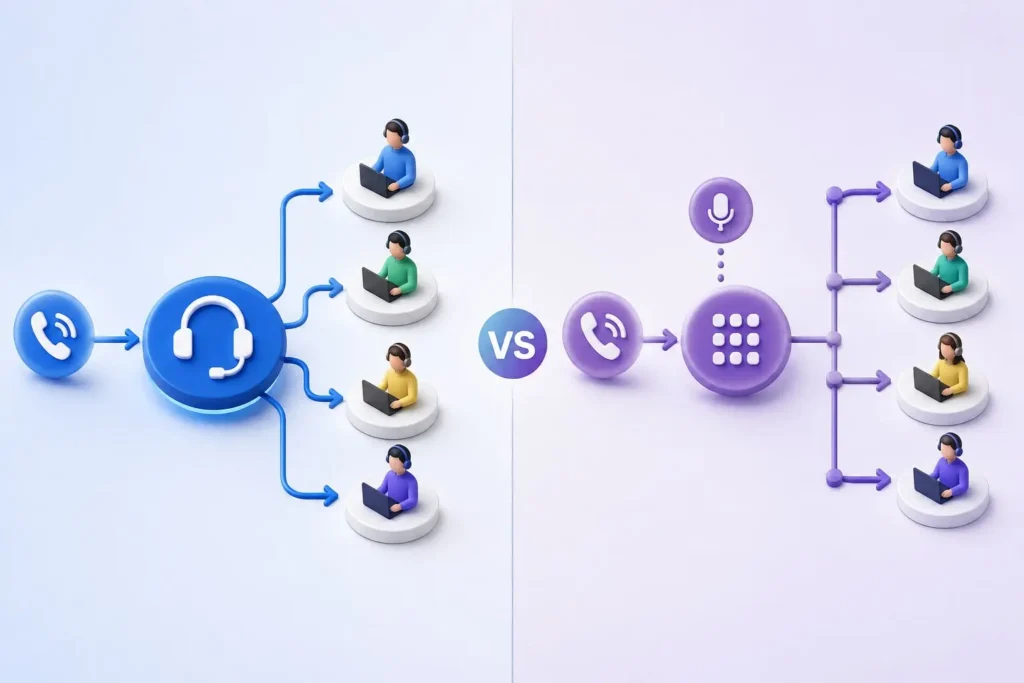
The key takeaway: IVR and ACD aren’t competing technologies; they’re usually two parts of the same workflow. The IVR figures out what the caller needs, and the ACD figures out who should handle it.
ACD vs Call Queue: Are They the Same?
Not quite, though they’re closely related. A call queue is simply where callers wait when all agents are busy — think of it as the holding area. An ACD system for call centers, on the other hand, is the broader technology responsible for intelligently distributing calls according to your configured rules, which includes managing that queue as one part of a bigger process.
In short: the queue is a feature, and ACD is the system that runs it.
Who Can Benefit From an ACD Solution?
Automatic call distribution isn’t limited to massive call centres; it’s genuinely useful across a wide range of industries in Dubai, including:
- Call centers
- Customer support teams
- Sales teams
- Telemarketing companies
- E-commerce businesses
- Financial services
- Healthcare organizations
- Real estate companies
- Travel and hospitality businesses
If your team handles a consistent volume of inbound calls across different departments, there’s a good chance an ACD setup could make daily operations noticeably smoother.
Why Choose an ACD Solution in Dubai?
Dubai businesses often deal with a mix of high call volumes, multiple departments, and increasingly distributed or hybrid teams. An ACD solution in Dubai helps address several of these challenges at once by:
- Managing high call volumes without overwhelming staff
- Supporting multiple departments under one unified system
- Improving overall call routing accuracy
- Supporting distributed or remote teams who need calls routed regardless of location
- Integrating with IVR and CRM tools for a more connected workflow
- Improving customer service operations across the board
At Call Center Solution Dubai, we help businesses set up ACD systems that are tailored to how they actually operate — not a one-size-fits-all package. If your outbound operations also need attention, our Outbound Call Center Solutions Dubai services are worth a look as well, since inbound and outbound call handling often work best when they’re aligned.
How to Choose the Right ACD Solution?
If you’re evaluating options, here are the factors worth thinking through before you commit to a call routing solution in Dubai:
- Call volume — how many calls does your business handle daily?
- Number of agents — how large is your team, and how is it structured?
- Routing requirements — do you need skill-based, priority-based, or simple round-robin routing?
- IVR compatibility — will it integrate smoothly with your existing or planned IVR setup?
- CRM integration — does it connect with the customer data tools you already use?
- Call recording requirements — is recording built in or does it need a separate add-on?
- Reporting and analytics — how detailed are the insights you’ll get?
- Scalability — can it grow as your team and call volume grow?
- Cloud/on-premise requirements — which setup fits your infrastructure and compliance needs?
- Technical support — what kind of support is available if something goes wrong?
It’s also worth thinking about your broader IT setup at this stage. A dependable IT AMC Service in Dubai can keep your systems maintained long after installation, and if you’re pairing your ACD with outbound dialling, a good dialer solution in Dubai makes a big difference too. On the infrastructure side, reliable IP PBX systems often form the backbone that makes all of this work together seamlessly.
Conclusion
At its core, an ACD solution helps businesses automatically manage and distribute incoming calls, connect customers with the right agents, and run their call centre more efficiently — without the manual guesswork. For Dubai businesses dealing with growing call volumes across sales, support, or multiple departments, an ACD solution in Dubai can be a genuinely important part of a modern call centre setup.
If you’re ready to stop losing calls to long hold times and mismanaged queues, it might be time to look into an ACD Solution Dubai built around how your team actually works. Get in touch with our team to discuss what a tailored setup could look like for your business.
FAQ
Automatic Call Distribution.
It automatically distributes incoming calls to appropriate available agents based on configured routing rules.
IVR interacts with callers and collects their input, while ACD uses routing rules to distribute calls to agents or departments.
Yes, many modern ACD platforms can integrate with CRM systems, depending on the platform and its integration capabilities.
Yes. ACD can be useful for businesses of different sizes, particularly those handling multiple incoming calls or departments.
It can help improve call distribution and queue management, which may reduce unnecessary waiting depending on configuration and staffing.
Not exactly. Features and routing capabilities vary between providers, so it’s worth comparing options before choosing one.
No. Businesses of various sizes, from small support teams to large call centers, can use ACD to manage call flow more effectively.
Many modern ACD systems support distributed teams, routing calls to available agents regardless of their physical location, depending on the platform.
Setup time varies based on business size, call volume, and how complex your routing rules are — simpler setups can be quicker, while larger operations may take longer to configure fully.